Beginner Strength Training Guide: Your First 8 Weeks
Learn the five movement patterns, how sets and reps work, and follow a simple 8-week, 3-day full-body plan to start lifting with confidence.

Walking into the weight room for the first time can feel intimidating, but strength training is simpler than it looks. This beginner strength training guide breaks lifting down into five basic movement patterns, explains sets, reps, and progressive overload in plain language, and gives you an 8-week full-body plan you can follow three days a week. By the end, you'll know exactly what to do each session and how to keep improving.
Why Beginner Strength Training Is Worth It
Lifting builds muscle and strength, supports bone health, and makes everyday tasks like carrying groceries or climbing stairs easier. The CDC recommends that adults do muscle-strengthening activities that work all major muscle groups on two or more days a week.
The good news is that beginners make progress quickly. In your first few months, you can expect to add weight to your lifts almost every week as your body learns the movements.
The Five Movement Patterns
Instead of memorizing dozens of exercises, learn these five patterns. Almost every lift is a version of one of them.
1. Squat: Goblet Squat
Hold a dumbbell vertically against your chest, feet shoulder-width apart. Sit down between your hips, keeping your chest tall and elbows inside your knees, then stand. Form cue: push your knees out in line with your toes. Common mistake: heels lifting or the chest collapsing forward. Progression: heavier dumbbell, then a barbell back squat.
2. Hinge: Romanian Deadlift
Hold dumbbells or a barbell in front of your thighs. With a soft bend in your knees, push your hips back and slide the weight down your legs until you feel a hamstring stretch, then drive your hips forward to stand. Form cue: keep your back flat and the weight close to your legs. Common mistake: rounding your back or squatting the weight down. Progression: conventional deadlift from the floor.
3. Push: Dumbbell Bench Press
Lie on a flat bench with a dumbbell in each hand above your chest. Lower the weights with control until your elbows are slightly below the bench, angled about 45 degrees from your body, then press up. Form cue: keep your feet planted and shoulder blades squeezed together. Common mistake: bouncing or flaring elbows straight out. Progression: barbell bench press or overhead press.
4. Pull: One-Arm Dumbbell Row
Place one hand and knee on a bench, back flat. Row the dumbbell toward your hip by driving your elbow back, pause, and lower slowly. Form cue: think "elbow to back pocket." Common mistake: twisting your torso to heave the weight. Progression: lat pulldown, then assisted or full pull-ups.
5. Carry: Farmer's Carry
Pick up a heavy dumbbell in each hand using a proper hinge. Stand tall and walk with short, controlled steps. Form cue: shoulders down and back, ribs stacked over hips. Common mistake: leaning to one side or shrugging. Progression: heavier weights or a longer distance.
Sets, Reps, and Rest: The Basics
A rep is one complete movement. A set is a group of reps done back to back. For beginners, 2-3 sets of 8-12 reps on most exercises is a reliable starting point.
- Rest 60-90 seconds between sets of smaller exercises and 2-3 minutes after big lifts like squats and deadlifts.
- Choose a weight that leaves about two good reps in reserve at the end of each set.
- Lower the weight under control, taking about two seconds on the way down.
- Write down your weights and reps so you know what to beat next time.
Progressive Overload Made Simple
Progressive overload means gradually asking your muscles to do a bit more over time. Without it, your body has no reason to adapt.
- Start at the bottom of the rep range. For example, 3 sets of 8.
- Add reps each session. Work toward 3 sets of 10 or 12 with the same weight.
- Add weight. Once you hit the top of the range for every set, increase the load by the smallest jump available and drop back to 8 reps.
- Repeat. Keep cycling through this pattern as long as your form stays solid.
Your 8-Week Full-Body Plan (3 Days a Week)
Train on non-consecutive days, such as Monday, Wednesday, and Friday. Alternate Workout A and Workout B, so week one is A-B-A and week two is B-A-B. Warm up for five to ten minutes before every session with light cardio and a couple of easy sets of your first lift.
| Weeks | Workout A | Workout B | Sets x reps | Focus |
|---|---|---|---|---|
| 1-2 | Goblet squat, dumbbell bench press, one-arm row, farmer's carry | Romanian deadlift, overhead press, lat pulldown, plank | 2 x 10 | Learn form with light weights |
| 3-4 | Goblet squat, dumbbell bench press, one-arm row, farmer's carry | Romanian deadlift, overhead press, lat pulldown, plank | 3 x 8-10 | Add a set, start adding weight |
| 5-6 | Goblet or barbell squat, bench press, cable row, farmer's carry | Romanian deadlift, overhead press, lat pulldown, walking lunge | 3 x 8-12 | Progressive overload each week |
| 7-8 | Barbell squat, bench press, cable row, farmer's carry | Deadlift, overhead press, assisted pull-up, walking lunge | 3-4 x 6-10 | Heavier loads, keep form crisp |
Planks go for 3 x 20-40 seconds. If you have no gym access, swap in the moves from our basic calisthenics exercises or the full-body home workout.
Gym Etiquette for Beginners
- Re-rack your weights and return dumbbells to their correct spots.
- Wipe down benches and handles after you use them.
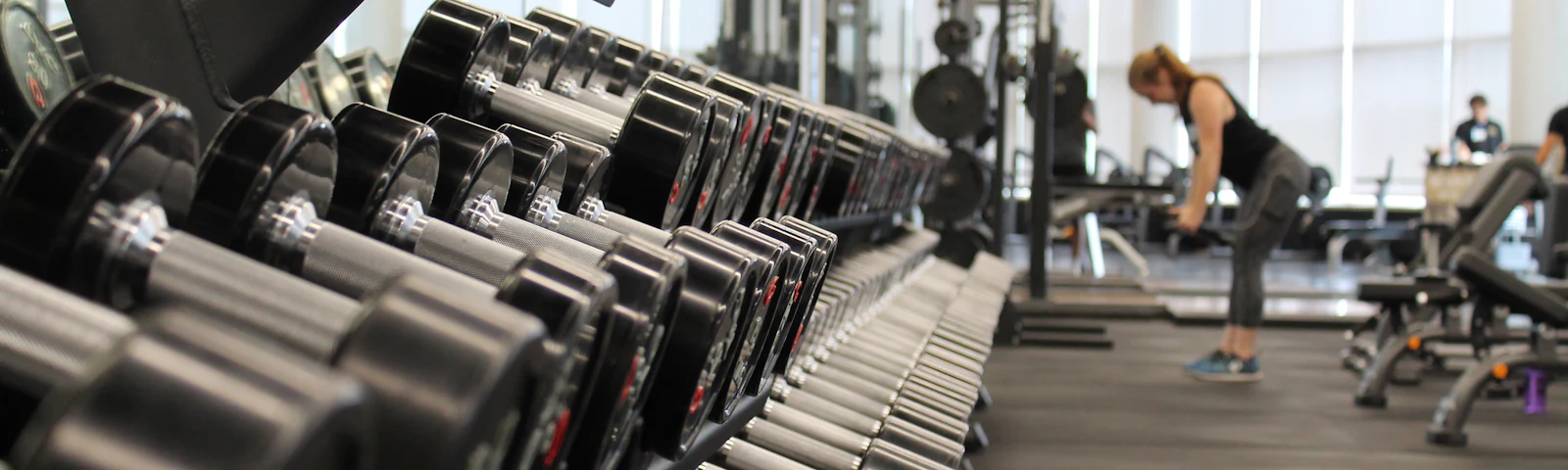
- Don't stand directly in front of the dumbbell rack while you lift. Step back so others can reach it.
- Ask before working in on equipment someone else is using.
- Keep phone calls and videos from blocking stations for long periods.
- Ask staff for help with equipment you don't know how to set up.
Recovery, Protein, and Staying Safe
Muscle grows between workouts, not during them. Aim for seven or more hours of sleep, take at least one full rest day between sessions, and stay active on off days with light walks.
Protein supplies the building blocks for muscle repair. Read our guide on how much protein you need to build muscle, then use the protein calculator to find your daily target.
Free interactive toolProtein CalculatorFind your daily protein target and how much to eat per meal.OpenStick with this beginner strength training plan for eight weeks, track your numbers, and you'll finish stronger, more confident, and ready for your next phase of training.
Frequently asked questions
How many days a week should a beginner lift weights?
Three full-body sessions a week on non-consecutive days works well for most beginners. It gives each muscle enough practice and enough time to recover.
How heavy should I lift as a beginner?
Choose a weight you can lift for the target reps with good form while leaving about two reps in reserve. If your form breaks down, the weight is too heavy.
How long until I see results from strength training?
Many beginners notice strength gains within a few weeks as their nervous system learns the movements. Visible muscle changes usually take longer and depend on consistency, protein, and sleep.
Do I need a personal trainer to start?
It is not required, but a session or two with a qualified coach can help you learn safe technique on lifts like the squat and deadlift. Filming your sets is another helpful way to check form.
Disclaimer: This article is for general information only and isn't a substitute for advice from your doctor, dermatologist, podiatrist or a registered dietitian. Check with a professional before starting a new diet, supplement, skin treatment or exercise program, especially if you have a health condition.
Keep reading
More Workouts
HIIT vs Steady-State Cardio for Fat Loss: Which Is Better?
Short and intense or long and steady? Compare HIIT and steady-state cardio, try a sample session of each, and learn how to mix both for fat loss.
30-Minute Full-Body Home Workout (No Equipment)
A complete 30-minute bodyweight session with a warm-up, 40/20 interval circuit, beginner to advanced variations, and a cooldown. No equipment needed.

The Beginner's Guide to Starting a Running Routine
An 8-week run/walk plan, a simple warm-up, easy pacing with the talk test, and practical tips to stay injury-free and motivated as a new runner.